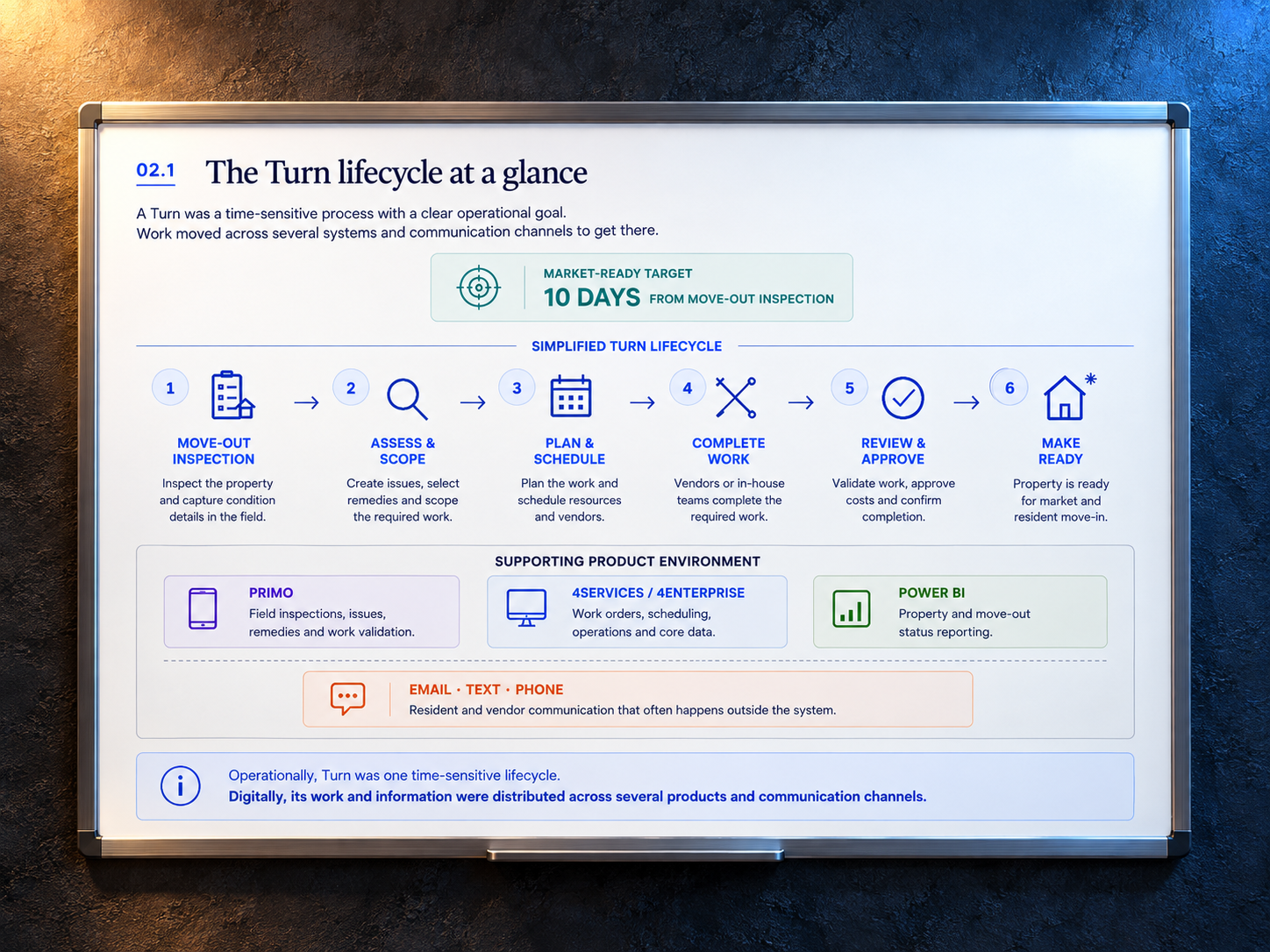
A Turn prepares a rental home for its next tenant: inspection, repairs and a final check that it is ready. Technicians do the work in the field; Field Managers coordinate people, progress and costs.
Across four days, I studied where AMH’s tools supported that process—and where people had to fill the gaps.
4 days · 2 days on site 2 technicians · 2 Field Managers
The deliverable
A prioritised research handoff Not a shipped-product redesign
One operational goal across several products. Ten days from move-out inspection was the market-ready target, not a result of this study.
01 / The central discovery
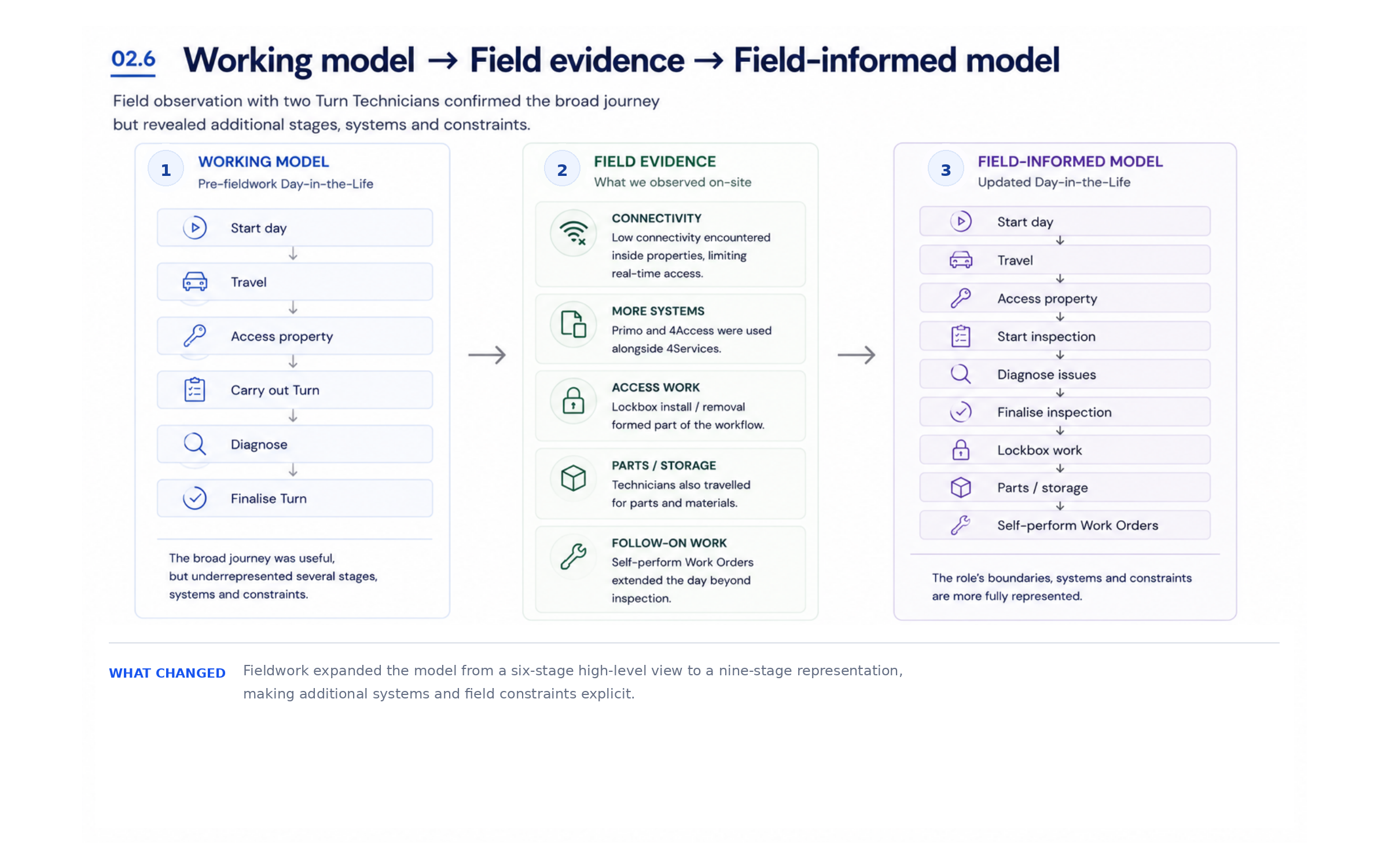
The journey described the task. The fieldwork revealed the job.
I observed technicians in vacant properties and Field Managers in the back office. The broad journey held up, but it underrepresented parts runs, lockbox work, additional systems and poor connectivity. These were requirements to investigate, not exceptions to ignore.
Inspect the journey ↗The change was to our understanding of the work. This is a research model, not a before-and-after product release.
Why this mattered
Designing only for the original model would leave recurring parts of the technician’s day outside the product conversation.
02 / From observation to direction
Not every breakdown needed another screen.
I separated the findings by the kind of response they needed. That kept a specific interface issue distinct from a workflow gap or an unresolved system dependency.
Decision
Information existed. It wasn’t in view.
The preferred visit time was on the Work Order, but hidden behind hover during scheduling.
Next step
Surface the preferred day and time at the point of action. Carried forward for later design.
Workflow
The day extended beyond inspection.
Parts runs, lockbox tasks and self-performed Work Orders expanded the technician journey.
Next step
Use the fuller journey to explore task requirements and support for poor connectivity.
System
Progress had to be pieced together.
Inspection detail and vendor updates did not travel consistently across the operational tools.
Next step
Investigate inspection-data continuity, vendor visibility and the Field Manager workflow.
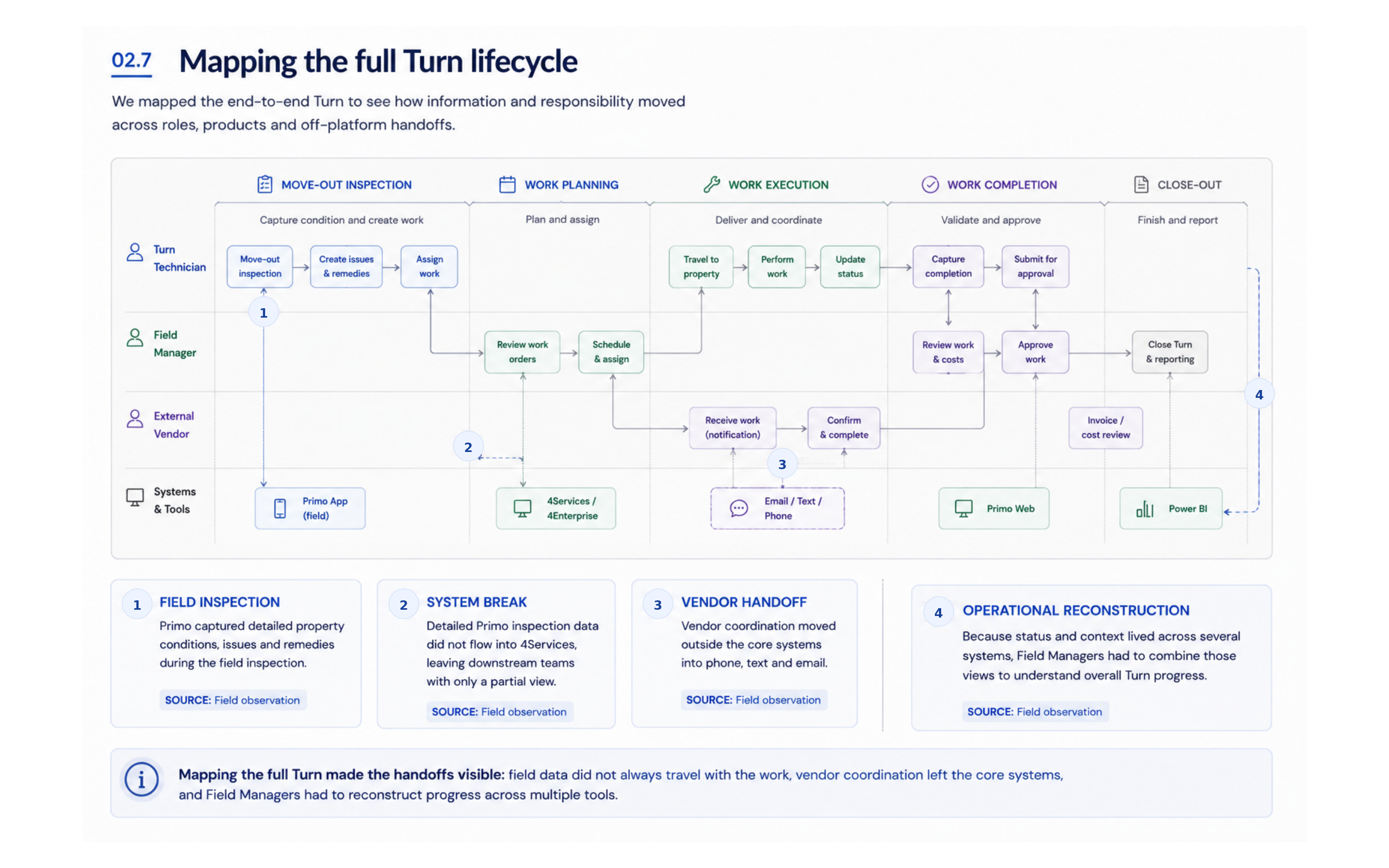
Look closer: where the lifecycle crossed product boundaries
The end-to-end map connected field inspection, downstream information gaps and coordination outside the core tools. It identified questions for product, technical and operational investigation.
Inspect lifecycle map ↗A supporting artefact from the research. The proposed responses still required investigation.
03 / The outcome
A clearer starting point for the next team.
The handoff connected observations to recommendations—and distinguished what was ready to act on from what still needed learning.
My contribution was the field-informed journey, lifecycle map and prioritised direction. Implementation and its impact were still to be established.
Clear next steps
Preferred visit-time visibility, missing Power BI data and training around written Work Order lists.
Further product design
Explore the fuller workflow and the task requirements revealed in the field.
Wider investigation
Integration, vendor participation and connectivity with technical and operational teams.
Scope of the evidence: two technicians and two Field Managers in Greensboro. The findings gave the next team a direction to test, not proof that every market had the same needs. No implementation impact is claimed.
The next conversation
That’s the short story. Let’s follow the evidence.
In an interview, I can take you through the reasoning behind the handoff:
01
What changed when I went on site.
The working assumptions and the observations that expanded the journey.
02
How I separated symptoms from causes.
Why similar friction led to different recommendations.
03
What the evidence could—and couldn’t—support.
Prioritisation, sample limits and the questions left for the next phase.